We get the Business Case, but let’s talk about the Business logic for Sustainability

If anyone were to ask the late American economist Milton Friedman what the purpose of business is, he would probably lean back on his nappa leather arm chair and retort, in a throaty Brooklyn accent, “to make a profit, dummy”! For the better part of four hundred years, since arguments in favour of economic liberalism were advanced during the Enlightenment, human beings have been looking to maximise profit. To accumulate wealth. To buy that new shiny G-wagon. Profit-maximisation has become the dominant logic of business, and much of human existence.
The Dominant Logic Phenomenon
Before we get carried away with the wonderfully potent odour of profit and financial liberation, let’s explore the idea of a dominant logic for a moment. In academic circles, a dominant logic simply describes the manner in which a firm or society organises much of its activity in order to be successful. Different periods have been dominated by a specific logic for success. In subsistence societies, the dominant logic was to survive. In agricultural societies, the dominant logic was production. In the rose-tinted world of capitalism, the dominant logic is to be profitable. This logic was especially poignant in the post-World War II era, when capitalism went through a golden age.
While accumulation and grandeur were the norm in the restoration of a post-war world, it might be time to reflect on the society we exist in today. Let’s lean back on our own nappa leather (or pleather) arm chairs and figure out if “success”, today, purely means profit.
A Society in Flux
In 2013, Indonesia-based Asia Pulp & Paper committed to a no-deforestation policy. This came after a protracted, decade-long campaign waged by green groups. Rhett Butler, forestry expert and mongabay.com, said: “The paper products giant may be abandoning business as usual for a very different approach – one that could change how forests are managed worldwide”. In 2015, Oxfam launched its ‘Behind the Brands’ campaign, which encouraged consumers to use their scorecard to tell large food and beverage companies exactly what needed to change in their supply chains. Kellogg and General Mills were identified as the worst offenders in harmful food production practices that contribute to climate change. Shortly after being cited, both companies committed to strengthened climate polices. In 2017, Hong Kong-based NGO Students and Scholars Against Corporate Misbehaviour (SACOM) launched a protest against technology giant, Apple. SACOM accused Apple’s suppliers of conducting corrupt trade union elections where workers were allegedly forced to vote for an assigned candidate with open ballot. “The union suppresses worker demands when labour disputes happen”, a representative of the group explained. Furthermore, the group claimed that Apple’s manufacturers were found to use student interns as young as 16-years-old to replace regular workers at large scale.
These cases of civic mobilisation could be interpreted as being symptomatic of a broader shift away from the “profit over everything” rhetoric previously croaked by the likes of Milton Friedman. Society is gaining a heightened consciousness of issues of resource longevity, ethical socio-economic labour practices and sustainable production processes. Shareholder activists are taking notice too, recognising the long-term profit implications of frivolous resource usage and the reputational risk of being targeted by labour groups. The dominant logic that has underpinned capitalism for much of the last century seems to be decaying in the court of public opinion.
Sustainability, a new Dominant Logic?
The term sustainability, derived from the Latin sustinere, can mean to maintain, support or endure. In the context of development, the Brundtland Commission of the United Nations explained that “sustainable development is development that meets the needs of the present without compromising the ability of future generations to meet their own needs”. Today, big business must grapple with managing operations and resources, in a way that does not compromise the future condition of its financial, social and ecological environment.
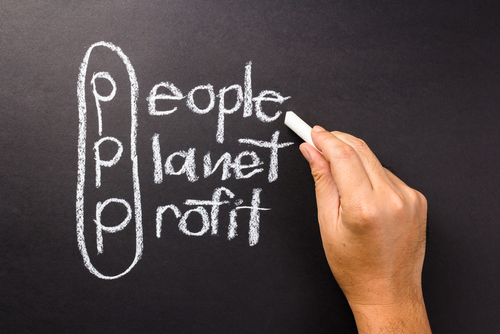
The dominant logic of sustainability means organisations pose the question “How do we find solutions to the potential impact our business has on our people, planet and profit”, and develop a strategy that addresses that question. One way of creating synergy between the three P’s, is through integrated thinking.
Integrated thinking is described as “the active consideration by an organisation of the relationships between its various operating and functional units and the capitals that the organisation uses or affects” [1]. Integrated thinking, if fully embraced internally by organisations, can lead to integrated decision-making and actions that consider the creation of value over the short, medium- and long-term. Companies can capacitate themselves to sustinere, by developing a dominant logic that improves, let alone preserves, their people, planet and profit.
In the era of social justice warriors and Al Gore-inspired climate change recitals, companies can no longer use sustainability as a reactive strategy to reduce the risks of law suits and clean-up costs from environmental damage. Sustainability, and integrated thinking, need to become proactive, solution-focused strategy rather than an operational tactic – a new dominant logic for the complexities of an ever-changing world.
Reference
[1] “Integrated Thinking” defined by the International <Integrated Reporting> Framework.
What is the difference between iXBRL and XBRL?
With the technical roll out of the XBRL programme by CIPC fast approaching on 1 July, 2018, there has been some confusion in the market place around the terminology which is sometimes used interchangeably. A common question we receive at Ince is
“What is the difference between iXBRL and XBRL?”
Thankfully, our resident expert on the matter Debbie Johnson, has answered the question below:
————————————————————————————————————————————————————————————
XBRL is the global standard machine-readable language, created specifically for all forms of financial reporting. Based on the global financial reporting rules of the IFRS and GAAP accounting standards, it allows the free, computer-automated exchange of financial big data, throughout the global financial reporting world.
It can be referred to as the “barcode” for all financial information, which allows for fast, automated, accurate and comparable analysis of all types of financial data worldwide. However, people generally cannot fluently read or easily understand XBRL language in its coded format so the next step in the evolution of XBRL was developed.
It is referred to as iXBRL which means “ Inline-XBRL”. This version of XBRL is human and machine readable. By combining XBRL with an HTML format, to form an XHTML format, it can produce XBRL information in a readable report, able to be easily consumed by people.
So iXBRL is the best of both worlds, because as a more advanced output format of XBRL, it can be consumed by both computers and people.
Ince has welcomed the fact that our South African regulator CIPC has jumped straight to iXBRL reporting; as the best output format for consumption and use of the XBRL financial reporting standard it has positioned South Africa in the forefront of global Standard Business Reporting.
Stay Woke: Making Sense of Shareholder Activism

The irrepressible former French statesman and relic of all things revolutionary, Napoleon Bonaparte, once uttered, “power is my mistress. I have worked too hard at her conquest to allow anyone to take her away from me”. His brazen meditation on the addictive and possessive relationship that those in power have with power itself has some resonance two hundred years later.
Today, our traditional definition of “power” has gone through somewhat of an extreme makeover: free market capitalism edition.
The political power that Napoleon once lusted over like a Gupta to a parastatal has now taken a new, financialised, form. The most powerful institutions in the world today – are corporations. Robert Monks tastefully remarks that, corporations, far more than any other institutions, determine the air we breath, the quality of water we drink, and even where we live. That’s quite hectic, Mr. Monks.
But just as the allies, through a tactful coalition, went on to defeat Napoleon at the battle of waterloo in 1815, a new coalition is looking to change the corporate power-complex in 2018.
Cue, shareholder activism – a phenomenon that is restructuring the relationship that shareholders have with profit-spinning corporations.
An activist shareholder is a shareholder that uses an equity stake in a corporation as leverage to put pressure on management to take certain policy decisions. Shareholders, however, don’t simply waltz around the bonfire of activism and sing Kumbaya for no apparent reason. They have motivations – we all do.

Effective shareholder activism chiefly aims at triggering substantive corporate change.
With corporations plundering the environment through unethical business practices and top management enjoying salaries higher than the Burj Khalifa, nimble shareholder activists are becoming an increasingly poignant part of the conversation on corporate governance.
Activists are researching every detail of the companies they invest in. From foraging financial results to analysing internal labour practices – even taking an interest in the vehicles used for deliveries. More than just shareholding Kumbaya singers, activists are placing a hypersensitive focus on the factors that may affect shareholder value creation – looking for weaknesses to ventilate at the next annual general meeting. They are staying woke.
With KPMG South Africa reeling after being fired by some of their top clients for being found complicit in the country’s state-capture saga, shareholder activists are using their collective muscle to drive an ethical, ESG-centred mode of corporate governance.
Shareholder activists have outgrown the negative caricatures of being corporate raiders, looking to squeeze a short-termist buck or two. Today, shareholder activists are at the forefront of democratising corporate decision-making. Making the circle bigger. Creating tension, necessarily so.
Top execs in some of the world’s largest corporations are vexed at the idea of this rampant shareholder activism. However, a quick skim of Dale Carnegie’s book How to Win Friends and Influence People would remind them: “Don’t be afraid of enemies who attack you. Be afraid of the friends who flatter you”.
The Semantics of Stakeholder Communications

A consortium of Maserati-wielding property developers is funding the construction of a new multi-storey shopping complex in a working-class suburb of central Johannesburg. Large retail chains are salivating at the prospect of opening their swanky boutiques and artisanal coffee shops while property-prices are set to soar as the area becomes desirable to investors. The allure of mass-produced chunks of moola is insatiable.
Exciting, right? – not for everyone.
Locals aren’t as enthused by the new development. Residents, occupying low-cost housing blocks, face the threat of eviction to make way for the new shopping gargantuan. Local shop owners are startled at the risk of having to close their operations amid inflating rental prices. Unions are irked at the possibility of their members experiencing jobs losses from the pending gentrification.
In true South African spirit, the three groups embark on frenzied protest action. Facing the threat of violence, construction of the new development is halted, the consortium of property developers is left red-faced and money, well, is invariably lost.
Tis the power of mass mobilisation.
But where, exactly, did our ambitious property moguls go wrong? Poor stakeholder communication would be a useful diagnosis.
More than just a fluffy corporate buzzword, stakeholder communication is becoming an increasingly important strategic tool for organisations the world over.
Defined as the process of integrating feedback acquired from stakeholders into an organisation’s operations – stakeholder communication is about inclusion.
“Wait, Stakeholders?” I’m glad you asked.
Stakeholders are parties or individuals that are affected directly, or indirectly, by an organisation’s operations. Remember the disgruntled residents, shop owners and unions? They were affected by the consortium’s hostile spatial takeover – therefore, were stakeholders.

Effective stakeholder communication is about learning what your stakeholders care about most, building mutually-beneficial relationships and creating trust.
When you communicate, however, is also important.
In the words of many a university-dwelling philosopher, stakeholder communication can’t be done a posteriori (after the fact). Keeping stakeholders on-side is about proactive consultation. Unearthing their needs and interests, before unwittingly trampling over them, can pre-empt any actions (i.e. mass mobilisation) that may affect the creation of value.
If the consortium consulted with residents and learned of their need for adequate and affordable housing, they may have opted to erect their heralded multi-storey shopping complex elsewhere.
The logic is simple, knocking on the door before problems arise is easier than after they do.
Creating systemic and lasting ways to communicate with stakeholders is not only helpful for crisis-aversion, but can also be useful strategically. On-going communication can help in gauging stakeholder expectations and increasing buy-in to strategic decisions (i.e. introducing a new product line, starting an online peanut emporium, launching a space programme).
We’re only scratching the surface with the value-add to stakeholder communication.
Gone are the days where organisations operated in echo chambers divorced from the outside world. Now, extending the proverbial olive branch to those affected can no longer just be an act of courtesy, but a rite of passage. Because as the Stanford Research Institute once lamented, stakeholders are those groups without whose support an organisation would cease to exist.
Ince on the cutting edge of iXBRL
Ince attended a CIPC workshop held on 26 March 2018, where all CIPC approved XBRL Software Service Providers (SSP), and CIPC’s appointed taxonomy service provider BR-AG, reviewed all aspects of the current taxonomy model.
BR-AG and CIPC confirmed that excluding any functionality changes that might arise from current testing, no further changes to the taxonomy were expected this year before “Go Live” on 1 July 2018. BR-AG then presented their rationale and plans to upgrade the taxonomy to include more recent releases of IFRS and iXBRL standards, as well as extend it to be more inclusive of local reporting requirements, such as BEE and JSE regulations. These items will be fully investigated and included in an updated taxonomy for the 1 July 2019 reporting cycle. CIPC also confirmed that no taxonomy extensions are allowed.
With the objective of XBRL being to reduce the costs and administrative burden and improve transparency when reporting, we at Ince, identified that achieving these goals requires reducing duplication and inconsistency in reported information to various institutions. The published IAR must be reproduced on the world-wide-web and reported in XBRL – “there is only one version of the truth”. Our journey towards achieving this objective, allowed Ince to revoloutionise our processes in terms of our one-stop software solutions, by creating our own locally developed and supported XBRL software. We are planning to gain international accreditation from XBRL before the end of the year.
Ince has successfully participated in the CIPC XBRL Pilot Programme and now moved seamlessly into a “live” production phase, in facilitating current submissions for multiple entities and their subsidiaries.
Some of our learnings gained so far have been compiled using the “Frequently Asked Questions” strategy (as well as the CIPC website) and below are some of the most pertinent summarised answers.
The first date for XBRL submission for every entity is determined by the anniversary date of their date of incorporation. The calculation of the first date of submission of an entity is different for close corporations and companies.
Entities are required to submit their latest final approved audited or independently reviewed Annual Financial Statements together with their Annual Returns, on the same day as their Annual Returns. The first date of submissions via XBRL, will be the first date of submission that falls on or after 1 July 2018, irrespective of the year of their latest final approved audited or independently reviewed Annual Financial Statements.
Holding Companies must submit their Total Consolidated Group (including Holding plus all local and overseas subsidiaries) and their own separate Holding Company results in the same instance file, which will be filed against the Holding company Registration number.
Each South African Registered subsidiary of their group, that currently qualifies to submit their PFS in PDF with their AR, will need to do so in iXBRL from 1.7.2018, against their own Company Registration number.
It is only the mechanism of submission, that has changed from PDF of AFS to iXBRL. So, the PI Score does come into it, but in the same way as it always has done.
XBRL expresses financial information in a clear, strictly defined, worldwide standards based, granular way, to enable computerised transmission, compilation and analysis of large amounts of data which produces meaningful, individually tailored, reports for multiple management and informational consumption purposes.
In XBRL , financial values are expressed as plain numeric characters with a specific accounting label/name that carries a specific “weighting”. It is that label with its attribute of + or – which defines the figure as a plus or minus (Debit/Credit) in the calculation linkbase. i.e. XBRL does not express numbers in brackets to indicate a minus function.
Integrated Reporting – A process and product worth rethinking
Rethink Results, Think Value!
Organisations do not exist in isolation from society and the greater environment. They are completely interconnected and rely on one another for long-lasting prosperity. It is within this context that organisations and investors have had to revaluate the way in which they assess organisational value and the long-term viability of a business model or investment.
In a time where business is expected to contribute to solutions for critical societal issues such as economic inclusivity and combatting climate change, financial information does not provide enough information to evaluate the future value and longevity of an organisation when it is isolated from an analysis of the organisation’s use of resources and their ability to sustainably satisfy stakeholder needs.
But how does an organisational leader go about analysing the push and pull between these different elements in order to determine a strategy for optimal long-term value creation? And how does an analyst determine the true value or the investment case of an organisation without looking further than the financial results?
Rethink Reports, Think Stories!
The International Integrated Reporting Council (“the IIRC”) with the support of the King Committee on Corporate Governance recommends that organisations produce an integrated report to replace what was previously known as an a nnual report.
An integrated report is a document that provides a concise, strategic overview of an organisation’s governance, strategy, activities and performance, with the purpose of providing enough information for all stakeholders to make an informed assessment of an organisation’s ability to create and sustain value, within the context of its external environment, in the short, medium and long term. It is intended to be more than just a summary of other communications (the financial statements, the sustainability report, etc.) rather, it makes explicit the connectivity of information to provide a story that explains how value is created over time.
Rethink Compliance Report, Think Valuable Tool!
Integrated reporting comes as a process as well as a product. As a process, it aims to elicit integrated thinking within organisations. This promotes a forward-looking and inter-connected approach to tailoring an organisation’s business model and managing an organisation’s strategy to create and sustain value through time, taking into account the relationship between financial, economic, environmental and social systems as well as the resources and relationships that an organisation us es and affects.
This involves a detailed analysis of the organisation’s strategy and operations that results in a clearer understanding of the organisation’s impact, risks and outlook. The resultant insights may lead to subsequent adjustments of the strategy and/or operations but will also provide the base to determine a set of key performance indicators that, when shared amongst the organisation, could provide incentive for improved performance.
As a product, an integrated report plays a vital role in an organisation’s entire stakeholder communications strategy. It provides an opportunityfor an organisation to show their stakeholders what they are doing to ensure that they will continue to add value to each of their key stakeholder groups in the short, medium and long term. These reports are becoming increasingly popular especially amongst investors who use integrated reports to analyse the value and long-term viability of an investment.
Rethink Additional, Think Integrated!
The International Integrated Reporting Framework (“the IIRF”), created by the IIRC, provides a basic guideline for compiling integrated reports. However, the IIRF has been created in a way that allows organisations around the world to prepare their integrated report in accordance with any existing (local or international) compliance requirements. In South Africa, for example, the IIRF provides a reporting framework to house the reporting requirements of the JSE’s Listing Requirements, the Companies Act, the International Financial Reporting Standards, the King Code on Corporate Governance, the GRI Standards, the Carbon Disclosure Project, the Equator Principles, the Code for Responsible Investment in South Africa and various other industry-specific regulatory/compliance standards.
For more information about the International Integrated Reporting Council, visit their website on https://integratedreporting.org/.
For more information about the South African Integrated Reporting Council, visit their website on http://integratedreportingsa.org/